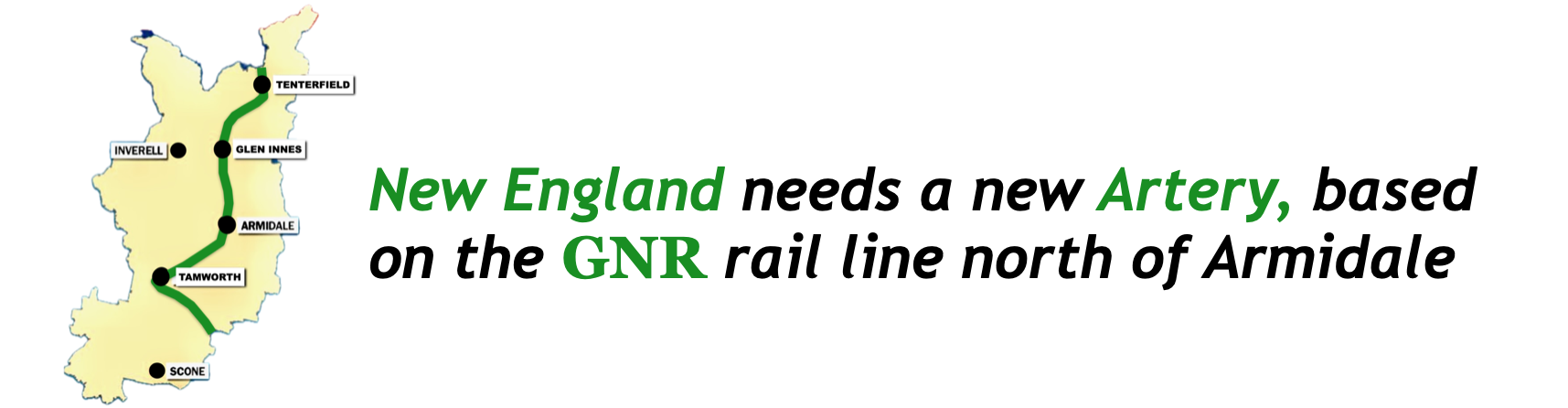
1. Vehicles
Motor vehicles will continue to evolve as technology progresses. Residents and visitors to the New England region will expect to be able to use the vehicles.
There are six major areas of change: –
1.1 Electric Vehicles will become the norm, and this change will require a major increase of the availability of electric charging points.
1.2 Much bigger trucks with multiple trailers will require significant road upgrades to operate safely These trucks will also be switching to alternate fuels
1.3 Community sentiment is requiring a higher level of road safety. This will require improvements to road safety infrastructure and community education.
1.4 Road speed will undergo change. The speeds on residential and retail roads will have lower mandatory traffic speeds whilst major highways will require higher speeds and higher average speeds. The New England Hwy is likely to be 110kph plus, and the journey time from Armidale to Wallangarra under 2 hours.
1.5 The drivers control of the vehicle will diminish as we progress towards full autonomous operation.
1.6 Vehicles will be fitted with more safety features and occupant injury limiting features.
2. Trains vs Trucks – the cost in Community Terms
* Sourced from Australasian Railways Association Schott submission.
In practice, prices paid by individual freight transporters do not necessarily reflect the actual costs incurred by freight activities. These unpaid costs or externalities are usually paid for by society e.g. higher prices at local supermarkets and hardware outlets.
Currently rail freight is carried from Sydney and other southern cities only to Tamworth. The XPT train from Sydney to Armidale does not carry any freight.
People talk about many more things aspects of freight costs e.g. Federal govt insistence that freight should be shifted from trucks to rail to meet net zero targets. Residents are also very aware that rod freight contributes a large percentage of carbon emissions.
New England region has to make its contribution. But without re-activating the GNR line for rail freight this cannot be achieved. And the volume of road freight on New England’s highways has grown dramatically by a factor of 300% during the east coast flooding in May 2025 severed the M1 route between Sydney and Brisbane.
There are cost savings to be achieved too. For example, a modern containerised freight train can carry the load of about 30 or more trucks.
There are various private enterprises in the New England region and adjoining regions like Southern Downs and Inverell, with major enterprises producing meat, fruits and vegetables, grain, tomatoes, etc. They can easily use freight trains if they were available.
For example there is a plan by a private company to start a meat processing plant in Guyra that wants to use trains to transport their produce to Tamworth and beyond. There is also an organic food manufacturer who is looking to move to Guyra and export their produce via Tamworth Intermodal nationally and possibly internationally.
Many private commercial enterprises in New England bring their goods from Sydney, Brisbane and Melbourne by road. One establishment in Armidale gets 12 truckloads daily. Likewise, hospital, university, and other public institutions also receive their goods by trucks.
3. Environmental Benefits
Rail accounts for over half of land-based freight transport. Even though road moves less goods by tkm, at the time of last analysis in 2019, road freight generated almost nine times as much CO2 equivalent emissions as rail freight.
When directly compared, rail freight produces 16 times less carbon pollution than road freight per Tonne Kilometre (tkm) travelled. A 1% modal shift away from road to rail, this would result in reduction in emissions nationally of 330,150 tonnes of CO2 equivalent. More detailed information is also offered below on the ambitious work underway within Australia, and with global partners, to move away from reliance on diesel and decarbonise above rail freight operations using alternative fuel types including batteries, electrification, hydrogen and ammonia.
4. Safety Benefits
Road accident costs are 20 times higher than rail for every tkm of freight moved. Based on Australian Rail Association (ARA) analysis, the annual total crash costs for road freight in Australia is estimated to cost over $3,000 million compared to the $282 million for rail freight.
A 1% shift away from road to rail would reduce accident costs nationally by $28.6 million per year. Further, NSW has a Towards Zero objective, yet the instances of road trauma are increasing. The opportunity to transfer volume to rail could help address the increasing number of heavy vehicle incidents which appear to continue to be rising in line with the growth in heavy vehicle permits, despite the arguments made about the introduction of new and higher-productivity vehicles being predicated on safety.
5. Health Benefits
Transport is one of the main contributors to air pollution in dense cities, resulting in negative health outcomes. Particulate matter causes breathing difficulties and exacerbates respiratory diseases, ultimately this leads to lower quality of life and reduced lifespans.
Rail freight generates 92 per cent less PM10 than road freight for each tkm of freight moved.
A 1% modal shift away from road would result in reduction in health costs caused by PM10 emissions nationally by $20.5 million annually.
Overall, a 1% shift of freight moved from road to rail will reduce accident, emission and health costs nationally by $71.9 million a year.
The major need for vehicles will related to providing the fuel or energy necessary to match the vehicles as they undergo change. A complicating factor could be that visiting vehicles may have needs different to the regions own fleet. At the current time the need for EV charging points is below demand.
6. Trains
Trains, worldwide are the major workhorse of the transport sector. Trains are capable of transporting people, freight and almost anything. Basically, the only limits are the loading gauge of the train and its axle loading,
Loading Gauge is maximum distance from the trains carriage or wagon any part of the load can extend. Generally, the trains loading gauge are set by the placement of rail infrastructure such as bridges, signals and tunnels from the track.
Axle loading relates to the weight each axle can carry, and this can be dependent on the type of train. Typically, freight train are about 25 tonnes per axle.
Rail tracks are selected to match the axle loading and speed of operation of trains to be operated. Tracks are fastened to sleeper at a predetermined track spacing known as track gauge. The New England rail corridor is standard gauge and most of SEQ is narrow gauge.
A clear need for reinstated trains from Armidale to Brisbane is for the tracks to all be standard gauge and for the line and trains to be consistent with all the NSW network and rolling stock.
In terms of train use the needs of the New England are similar to the needs of all NSW.
Passenger trains must be frequent, offer good journey times from point to point and connect to commonly frequented locations. The fares need to be reasonable, and the train need to offer “car like comfort”.
Freight trains must be capable of transporting bulk freight like grain and cotton, containers and other.
There are two distinct needs for freight in the New England Region.
Firstly there is considerable need for freight to pass through the New England. Examples include: –
- Fruit, vegetables and horticulture produce grown in the Stanthorpe to Gatton region destined to the Sydney markets
- Groceries and Homewares imported into Sydney destined for Queensland markets
- Items manufactured in Queensland destined for markets in NSW and Victoria etc and visa versa.
- Grain produced in Northern Inland NSW destined for North Coast Markets and vice versa.
Secondly freight generated within the New England destined for consumption within the New England Region r vice versa.
The quantities will range from a few kilograms to full freight train loads.
Currently most freight passing through or being moved within the New England region is being transported heavy articulated trucks.
7. Buses
Technically buses will undergo changes similar to all vehicles however the change is likely to be slower as the New England bus fleet is generally older and vehicle turnover slow.
Changes in bus monitoring and bus management will be significant as communications between bus authorities, bus operators, depots, drivers and passengers adopt new technologies. Vehicle and passenger tracking equipment will enable better operations and passenger service.
Depot staff and drivers will need additional skills and training to install, use and maximise the new technologies effectively. This will be an important component of offering the combined School Bus and community on demand services.
The return of intertown, intercity and interstate coach services is an option that may suit many travellers.
A common item in the truck and rail industry is the Intermodal centre or terminal. The function of this facility is that it is a large “building” designed to move freight from train to truck and visa versa. They then become the feeders for distribution centres that break the freight cargo down from containers into smaller units for distribution to shops, businesses and all end customers.
A common item in the bus, train and passenger transport industry for moving passengers from one mode to another mode of passengers is the Interchange. This is again normally a large building that can handle trains, route service buses, coaches, taxis and all other forms of passenger transport and in a very efficient, seamless cost-effective manner to allow the transfer of passengers between the modes. Roma St Station in Brisbane and Central Station in Sydney are examples of large interchanges.
The New England will need both intermodals and interchanges at key locations. Armidale and Glen Iinnes are both obvious locations.
8. Planes
Aircraft are an important mode of transport however their use is very limited by the extremely high cost $300 to $800 is simply beyond the reach of most people especially if more than one person is flying. Most passengers are either very wealthy or funded by their employer.
Reduction in air fares and an increase in frequency would be nice but unlikely. An increase in aircraft operators may stimulate competition.
Coach services and passenger rail services hopefully can bridge the gap and provide affordable travel to and from the New England Region.
9. Active Transport
The 2024 April – June quarter figures presented on the Tweed Rail Trail website indicate a noticeable decline in numbers of users from quarters
< needs a link to where this usage data was published >
Usage numbers appear to have declined considerably between the same quarter of 2023 and 2024 (April to June), putting into question the real benefit to local businesses of simply having a recreational path (rail trail). Instead, there is a need to have both train services and a recreational path sharing the railway corridor for the varied travel needs of the community members and the many visitors to the Northern Rivers region.
A regular train service can transport people faster over longer distances, in comfort and safety. Trains will carry luggage, prams, bikes, surfboards and wheelchairs. People can visit other towns along the line, go shopping, visit friends, sightseeing or have a couple of drinks and get home safely, with an electric minibus connection from the station. Riding a bike or walking provides limited options and is vulnerable to weather, distance and daylight hours mostly. It begs to reason that we should have both low emission trains and a recreational path sharing the valuable rail corridor.
On top of these declining figures a report by the Northern Regional Joint Organisation of Councils (NRJO) has revealed that to extend a walking/cycling trail between Lismore and Yelgun (or Crabbes Creek) will cost between $87.5 to $94.5 million.
Rick Banyard
Project Director
New England Network
3-jun-2025
