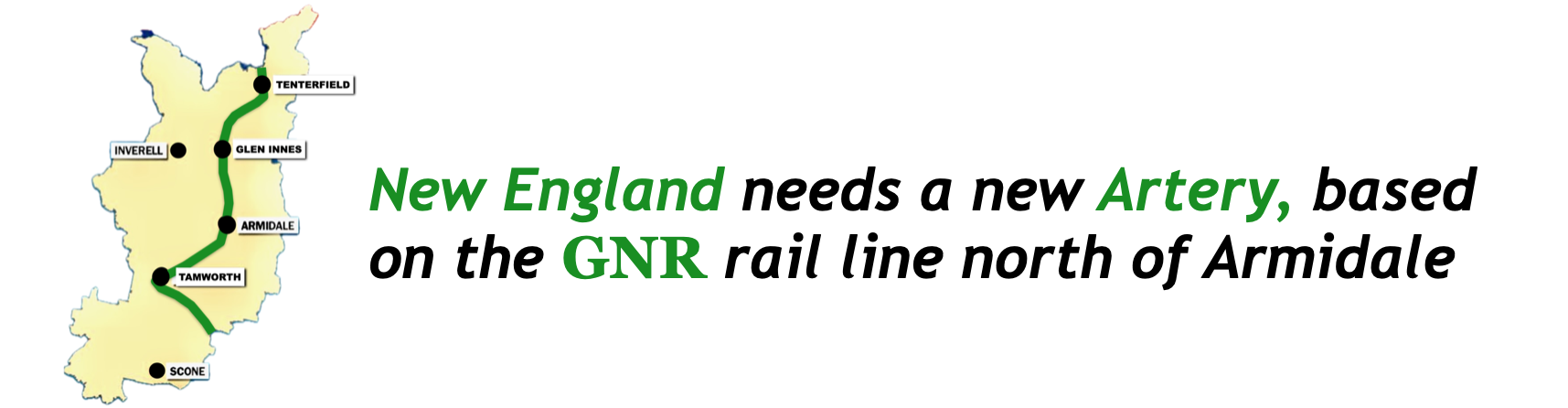
In order to dramatically improve the future of transport in the New England New England Transport Plan offers the foillowing recommendations:-
A. Major Recommendations
B. Minor Recommendations
A. Major Recommendation
A. Major Recommendations
A1. Redefining the New England Region
That the Local Government Areas of Armidale Regional, Glen Innes Severn, Inverell, Tenterfield, Uralla and Walcha be recognised by all government agencies and businesses as the New England Region.
The New England is a location that now seems to be without a unified definition. e.g. New England Health, New England state electorate, New England federal electorate, health services, etc, They all seem to have differnt boundaries.
This causes difficulties in funding, communications, identity and promotion.
The following map of New England highlights this problem,
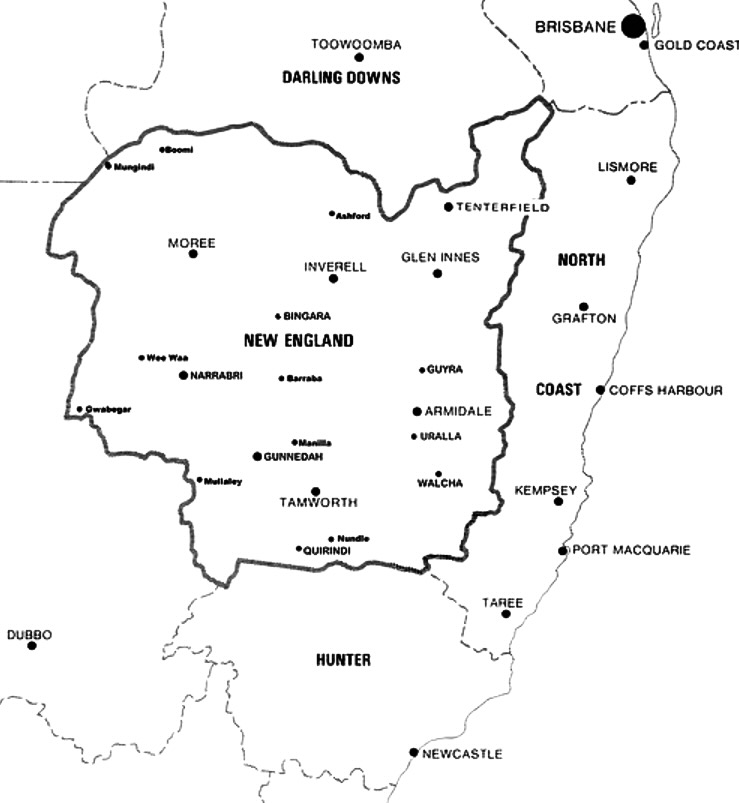
One New England will greatly enhance the profile of the Region and deliver better health, education and tourism etc.
The likely cost would be very low as the savings of having a unified and clearly identifiable region would in the long term outweigh the cost.
Funding and resources are commonly distributed by governments and agencies on the basis of statistics. If the statistic are not collected by clearly defined regions then the New England Region may be bypassed (or over rated). Having a clearly defined and recognised Region must therefore be highly beneficial.
Action Plan
- Form a working group of the Mayors of the New England Region and have all Councils committed to the formal recognition of a New England Region.
- Seek the formal definition of the Geographical Names Board of the New England Region.
- Promote and publicise the New England Region
A2. Registration of Cycleways
That all cycleway routes be: –
- documented for the New England Region in a register maintained by the tourist centres of each LGA.
- evaluated for their role in providing Active transport for the region.
- And determine the economic and tourism benefits to the New England Region.
The New England region has as many as 1000 documented and recognised cycleways and proposed cycleways, covering some 25,000 route kilometres. Some are operated by local government organisations or associated bodies such as Tourist Information Centres.
There is seriously abdication of formal recognition of such facilities, maintenance responsibility and insurance is questionable.
These cycleway facilities include both in use and proposed Cycle Trails, Shared Pathways and Rail Trails and may be used by bicycles, tricycles, penny farthings, e bikes, scooters, e scooters, mobility aids and even horses and as walking trails etc.
The formal recording of bicycle cycle facilities, their use and ownership is the first step in measuring the benefits, risks and likely costs of these structures. It may also assist in determining insurance liabilities and maintenance responsibilities.
Hopefully a register will stimulate greater usage, foster greater safety and maximise their tourism potential.
The cost of developing the register should be small and basically involve setting up a shared database. The New England Transport Plan Network can contribute considerable start up information.
The benefits can be measured in terms of: –
- cost of establishment, improvements and maintenance.
- User numbers and time of use.
- Tourism numbers and spend.
- Type of use.
Action Plan
- The Tourist Information Centres establish a working group and enlist stakeholders and Community members to commence the Data Base and develop an operating process and procedures.
- Set quarterly goals and targets and review as necessary.
- Make the trail information available on a public web site with provision to limit access to confidential information.
- Actively encourage the use of the cycle trails in all their forms via solo use, events, tourism packages etc.
- Seek funding to assist with this project and if possible employ a project officer.
A3. Reclassification of School Buses
That all school bus routes in the New England region be converted to combined School and On Demand public bus services.
The New England region has about 150 school bus routes that service nearly all the schools in the region on a twice daily basis.
Morning services arrive at the schools about 8:30am and depart on the homeward journey about 3:15 pm.
The School Routes are all numbered individually and set down and pick up at nominated schools. The routes are well documented, and many have tracking technology.
There is a considerable degree of confusion about who can travel on school buses and what fares apply. School Bus passes are issued by the school of attendance and authorise travel to that school.
Commonly school buses only operate for about an hour on each of the morning and afternoon journeys. The bus capacity is matched to the number of students travelling. Seat belts are now a requirement with one student per seat.
All School Buses have vacant seats for as least part of their route.
School buses represent a major investment in the New England Region by the Government and charter operators.
Rural communities have family members, visitors, staff and others who are not qualified to be issued with School Bus passes however may be able to make great benefit to their transport needs by using the school bus.
By offering “on demand” options, the school buses could greatly extend the public transport provision to the total community and give the bus operator extra patronage and revenue.
The on demand operation would operate via a call centre with 1800 number to take bookings and advise the driver.
Some bus operators may wish to operate “on demand” services that operate outside their school contract hours.
School Buses operate under a contract with the NSW Government with fares supervised by IPART. Remuneration would flow to the bus operator via an extra payment under the contract, or via a payment from the passenger, or a combination.
School bus operators may see the On Demand Service as an opportunity to increase their bus business by running extra services between school runs or by extending the school bus route to another location. Eg rail station or hospital after the school drop off.
There is a large proportion of the New England population who are unable to drive or do not have a car available and On Demand Bus service may be a realistic option to improve their mobility.
Employers may find it easier to attract staff to isolated locations.
Bus Operators may gain passengers to occupy spare seats or utilise empty running periods.
Action Plan
- Establish a working group to develop an On Demand bus service for the New England region.
- Modify the school bus route contracts to allow School Buses to carry passengers additional to the school students.
- Introduce an online booking system.
- Introduce OPAL ticketing to school buses.
- Promote and market the On Demand Services.
A4. Train service Sydney – Armidale
Substantially improve the train service to Armidale from 1-jul-2025 by increasing frequency and number of services to three services per day, reducing journey time, increase seat availability, and introducing Opal ticketing.
For the last 20 years the Xplorer train service from Sydney to Armidale has operated a daily day light service departing in the morning and arriving in the late afternoon. There is a Rail Coach service that extends from Armidale to Tenterfield and Inverell meeting both the inbound and outbound services.
The journey requires seat bookings and is commonly fully booked for parts of the journey.
The journey time is currently about 8 hours to Armidale and 12 hours to Tenterfield. The lack of OPAL data seriously hampers the evaluation of the service usage and service delivery.
Rationale
The people of New England Region need access to the rest of NSW and in particular to the cities of the Lower Hunter, Central Coast and Sydney via public transport. For education, health services, sport, entertainment and tourism.
Frequency is critical to service patronage and one service per day is totally unreasonable.
It would be feasible to run the extra services only to Newcastle (Broadmeadow) and then passengers making use of the Inter City trains to Central (or joining the proposed High Speed Rail).
The cost of operating the Xplorer train between Sydney and Armidale in dollars per Kilometre terms is unknown. However extra distance is likely to be at the same cost per km.
If the cost of train operation is measured in terms of safety, convenience, timeliness, productivity of passengers, and health benefits the cost of not having a train service is very significant and would more than justify the operation of the train.
There would be cost and time savings by using the Inter City Trains for the segment between Newcastle and Sydney.
Combining the with the Inter City services may also allow Newcastle to Central to have a fast train service from mid 2025.
The electrification of the rail line from Broadmeadow to West of Maitland would offer considerable savings to both the existing services and the new dual fuel trains.
The operation of additional train services south of Armidale would have a major positive impact on the residents and visitors of the New England. Extra train services would reduce costs the residents, significantly boost tourism and improve connectivity.
An Express train service from Broadmeadow (or Maitland) with stops at Gosford, Hornsby and Central would be of immense benefit to all as it would give: –
- a 2 hour and 10 minute journey time.
- Save energy and emission by using electricity in place of diesel.
- Extend the life of the Xplorer.
- Increase the availability of the Xplorer for other duties such as additional services to Armidale. or a service from Armidale to Wallengarra.
- Changing trains at Maitland my cause some minor concerns but would be compensated by a quicker journey time.
Action Plan
- The NSW Minister for Regional Transport Establish a working group of stakeholders, community members, TfNSW and passenger train experts to recommend options to greatly improve passenger rail connectivity between Central Station and Armidale. The first report due at the end of the first three months.
- Undertake feasibility and resourcing studies as a matter of urgency.
- Develop operational strategies, plans and timetabling and run trial to test the proposals.
- Implement the changes in the second half of 2025.
A5. Train service From Armidale to South East Queensland
That rail services from Armidale to South East QLD (SEQ) be reintroduced to provide of passenger, freight and heritage services as soon as feasible and that the prime operator be the NSW and QLD governments with support and commitment from the Australian Government.
There is considerable evidence available to indicate that there is need for passenger, freight and heritage rail services in the New England region using the existing rail corridor.
There is a large volume of evidence that the population and economic activity will undertake massive growth and expansion over the next 30 years.
The QLD Government has announced it will reopen the rail line to Stanthorpe.
The Council of Mayors’ (SEQ) People Mass Movement Study, with a comprehensive road map of 47 priority projects, is aimed at reducing gridlock in the region.
There will certainly be a major impact on the New England region when it starts to mesh with 1 in 7 Australians who live in SEQ – 3.5 million and rising to 5.3 million by 2040.
The New England must be ready to capitalise on the Brisbane Olympic Games in 2032.
The 210 km rail corridor is all there and an estimated $500 million will allow it to run trains within 12 months.
NSW simply cannot ignore the very rapid growth and development of SEQ.
SEQ is to undertake a major upgrade and expansion of its own rail provision.
Detailed planning is about to ramp up for the Inland Rail connection from Toowoomba to Brisbane or Gladstone.
Revenue will start to be generated as soon as trains start running and the revenue will keep rising for the foreseeable future. $500 million will start the trains rolling.
Benefit
Every person in the New England region will benefit from the economic benefits of a rail service. Almost every farmer will benefit from better rail freight connections with the Port of Newcastle. This should lower freight charges. NSW will be a major winner.
Action Plan
- The NSW Treasurer to seek assistance from the Australian Government.
- TfNSW should facilitate the reopening works and engage the necessary contractors.
- Locate the necessary rolling stock to assist with the repairs and initial services.
- The NSW Government in conjunction with the Australian Government should negotiate a cross-border agreement with the Qld Government for the trains to be able to move freely between states.
- Commence operating train services in July 2025.
A6. Train service From Moree to Grafton be established.
Recommendation
That rail services from Moree to Grafton be introduced to provide of passenger, freight and heritage services as soon as feasible and that the prime operator be the NSW Government with support and commitment from the Australian Government.
The original planning of the NSW Rail network in the 1850’s to 1890 envisaged that this line be designed, funded and built. Works started at Moree and headed east. The line to Inverell was completed and made operational. The line from Inverell to Glen Innes was planned but never made operational. Glen Innes to Grafton was not attempted due to funding issues, etc.
The reason for the need for the West-East rail line were sound then and are still sound in the 21st century.
From tourism, recreation and social interaction to freight and rail operational efficiency this line will be a major winner.
This West-East line will deliver to 2 loops – the north loop via Brisbane and the south loop via Maitland and Werris Creek.
The establishment of loops in all rail networks is highly desirable as it eliminates terminating trains and makes freight and passenger services shorter.
Revenue from this line should be very comparable with the best of the other network lines and will lead to;-
- Cheaper freight costs,
- Speedier freight handling,
- Less empty running,
- Greater resilience for the network as it would reduce closure time from fire and flood.
- The ability to promote attractive rail tourism in and through the New England.
Action Plan
- The Minister for Regional Transport Establish a working group of stakeholders, community members, TfNSW and passenger train experts to recommend options to greatly improve passenger rail connectivity between Moree, Glen Innes and Grafton. The first report due at the end of the first three months.
- Undertake feasibility and resourcing studies as a matter of urgency.
- Develop operational strategies, plans and timetabling and run trial to test the proposals.
- Develop First Class high end Rail Tourism packages for the loop from Newcastle to Grafton to Grafton to Inverell to Moree to Narrabri to Quirindi to Muswellbrook to Newcastle.
- Commence reopening and building the track in 2025.
- Compete the project by the end of 2026 .
A7. Establish a Stakeholder Reference Group, for their contribution to the vital conversation about maintaining and growing the rail freight advantage.”
When the NSW Government establish an A quality rail freight network in NSW would be a key to the prosperity of NSW as freight movement is fundamental to productivity and profitability of NSW. A Stakeholder Reference Group would contribute to this vital conversation about maintaining and growing the rail freight advantage.
Traditionally rail has provided a major contribution to the states agricultural and mining industries. Traditionally, most product including coal, grain, wool and cotton lends itself to bulk handing. The use of containers is now a key mode of efficient freight movement.
The Inland Rail is championing container movements with 3,600 metre long double stacked long distant trains.
It goes without saying that if NSW wants a better rail network it must involve all stakeholders and collaboratively work together to deliver the best possible outcome.
The cost of a Stakeholder Reference Group is likely to be relatively low and many members will probably self-fund. Quality decisions are also likely to contribute to cost savings and productivity gains. It would be reasonable for the organisation to be self-funded.
Stakeholder Reference Group will no doubt work hard to deliver the best rail network possible thus reducing freight costs, helping to contain the cost-of-living pressures and delivering maximum revenue to NSW.
Action Plan
- The Minister should immediately form the Stakeholder Reference Group and provide seed funding and core staff including a CEO.
- The Minister should consider using the Hunter Valley Coal Chain Coordinator organisation as a business model for the Reference Group.
- The Minister should require a quarterly report from the organisation.
- The Stakeholder Reference Group should report to the Government on rail and road freight transport issues in order to raise the share of rail freight.
A8. Need for EV charging points
Recommendation:– That a full evaluation be undertaken for the need, quantity and location for charging points for electric vehicles including cars, trucks, buses, motorbikes, e bikes and associated e mobility devices and that the identified need be satisfied as a matter of urgency.
Electric Vehicles (EV) and devices are rapidly becoming common forms of transport and Active Transport using a low Carbon fuel. They offer advantages in mobility, emissions savings and mobility. Dual mode vehicles also assist with providing modern transport. There is potential to draw energy from the New England REZ.
The uptake of EV’s is strongly related to the ability to charge their batteries easily and cost effectively. Fossil fuel like petrol is readily available in the community and end users expect similar availability.
Many of the charging points available within the community have to date been provided by energy suppliers, EV makers, and energy suppliers. Motels and tourist ventures have also supplied charges with many providing no cost or low-cost power. This trend should continue.
The ready availability of charging points stimulates the use of EV’s and in turn the quality of the environment.
Action Plan
- Councils should register all public EV Charging points.
- The list should identify locations for additional chargers.
- Councils should organise the installation of additional chargers.
A9. Audit bike trails to quantify benefits
That all bike trails be registered and audited to quantify the economic and tourism benefit to the locality in which they are placed. The audit should also record the maintenance expenditure and cost.
By legislation, it is Councils’ responsibility to manage their assets. It is only reasonable that councils account for their operations and justify expenditure to their ratepayers and residents.
Councils typically determine the cost of ownership of assets including pools, libraries and tennis courts. The cost of ownership and economic benefit determines ongoing operation and new investment. Bike trails should be treated in a similar manner and councils should withdraw from ownership of sub-standard assets. New projects can also be compared against existing assets.
A10. Major Upgrade of the Ardglen Tunnel
Pressure the NSW Government to complete a major upgrade of the Ardglen Tunnel to provide a dual track tunnel, at grade, capable of handling double stacked containers.
The Ardglen Tunnel was built in1876. It crosse the Liverpool Range at Murrurundi on a section of track that is too steep to allow modern freight trains to use without at least two banking locos. This is very expensive and time consuming. The track needs to be twin track with twin tunnels capable of permitting double stacked container trains. The new tunnel needs to be at grade (near level).
If the Ardglen Tunnel is not rebuilt the total rail network in NSW could be thrown into chaos if a train mishap, fire or structural fault closed the tunnel.
Even if the tunnel remains operational it is simply not capable of delivering the rail services demanded.
Likely Cost: This project is a major tunnel boring task and will be expensive. However if the tunnel fails and can not be used the costs incurred will be massive. Clearly an urgent planned rebuild will deliver the most cost effective solution.
Benefit: Lower freight costs, large trains, no banking locos, reduced journey times and a lower tunnel cost are very clear benefits.
Action Plan
- Establish a project team to deliver the new tunnel
- Seek a suitable tunnel boring machine and associated consumables.
- Develop plans and specifications.
- Secure the funding
- Build the tunnel
- Complete the associated works and commission the tunnel for rail traffic.
B. Minor Recommendations
The following recommendations could be introduced independent of the major recommendations above, to gain reduced benefits for the New England region:-
B12. Opal ticketing: be used for all Trains NSW rail and coach services and all other public transport including school travel, in order to provide access to patronage from the ticketing data.
B13. Improve Coach Services: from Dubbo to Tamworth and Port Macquarie to Tamworth be extended to Armidale. Ensure synchronisation with the rail services in order to increase patronage on the services and provide greater travel options for the community.
B14. Coach Services: to be authorised to carry parcel freight in order to provide another source of revenue to operators and increase freight connectivity for the community and businesses.
B15. NSW agencies to work collaboratively: require all government agencies to work collaboratively to expand and make viable the taxi and Uber services in the New England, for the benefit of the community.
B16. Connectivity with Wellcamp Airport at : Freight and Passenger connections and links should be identified and developed between New England this internatiuonal passenger and freight airport at Toowoomba. QLD.
B17. Heritage railway rolling stock and infrastructure are very important to tourism and must be provided for and safeguarded from being scrapped by regulations.
B18. Turntable at Armidale: to be preserved as a working item of infrastructure.
B19. New England roads network: needs a long-term plan to upgrade the major thoroughfares substantially and bring them up to a Statewide standard.
B20. Footpath and Pathways: Require all councils and land managers to adopt a strategy to always consciously consider the inclusion of footpaths, shared pathways, waterways and activity spaces along the side of all roadways, transport corridors and water-based structures.
B21. Highways: Will need expensive major upgrades to accommodate the much larger trucks now being introduced, unless the GNR rail line ius re-activated by 2032.
B22. Councils in the New England Region: need to collaboratively develop and instigate a unified road safety upgrade program.
B23. Safety Issues for Walking: identify and address the safety issues towns and villages of the New England are lacking in active transport options. Many locations completely lack of safe places to walk, when everyone walks or rides in the middle of the road pushing prams walking little kids. It’s dangerous. The closer to town centre the worse it gets. Projects like rail trails frequently absorb scarce funding and resources that should be used more prudently.
B24. Improved integration: of active transport in regional NSW and in particular the New England. The integration of active transport with day return trips on trains, coaches and on demand buses, could be facilitated by improving facilities at stations and stops, and enabling bikes to be better stored safely on buses, coaches and trains.
B25. Upgrade rail corridor west of Muswellbrook: Pressure the NSW Government to promptly complete a major upgrade of the rail corridor be Muswellbrook to Werris Creek to dual track capable of handling double stacked containers.
B26. Rail services between Armidale and Newcastle: Pressure the NSW Government to introduce 3 new daily return passenger services – morning, afternoon service and an evening service.
B27. Tamworth Freight Terminal: introduce a daily container rail freight service between Tamworth and Armidale.
B28. Pedestrian Access and Mobility Plan (PAMP): all seven local councils in the New England should have current Walking and Mobility Plans and allocate funding to annually increase the share of formal footpaths and shared pathways in their LGA.
B29. Walking pathways: Large scale pathway development should be undertaken in Armidale and the towns and villages of the New England. There is also considerable need for structured pathways at tourist attractions and points of interest.
B30. Walking/cyclimng paths: In locations where a recreational pathway prevents or restricts the operation of a train service the potential economic loss caused by the recreational pathway must be deducted from the revenue attributed to the pathway.
B31. Residential streets in suburban areas: should have lower speed limits and more calming structures to improve safety in accordance to road design policies.
B32. Improvements to major roadways: Raise the maximum speed limit to 110 kph and the average speed increased to allow 100 kph.
B33. LInks to Dorrio from New England: Seek a public transport option to connect the Dorrigo Steam Railway and Museum to New England’s public transport network in order to tap the tourism potential. A dual road-rail corridor could be considered to allow rail movement between the Dorrigo Museum and the Main North Coast line just north of Coffs Harbour.
B34. Inter-capital rail travel times: Support ACT Labor’s announced plans to work with the NSW Government to reduce the rail travel time between Canberra and Sydney. Faster rail travel times between Sydney and Melbourne will have spin-off benefits for producers in the New Enland to reach new markets.
B35. Cross-border Transport Working Group: New England stakeholders must encourage the NSW Government to support QLD’s call to establish a cross-border working group to investigate priority areas to re-establish the Armidale – Wallangarra – Brisbane & Toowoomba routes.
B36. Guaranteed Freight rail slots: The NSW Government needs to guaranteed rail slots for freight from the New England to Port of Newcastle. This will allow just-in-time delivery, reduce storage costs and improve producer returns.
B37. Bus depot staff and drivers: will need additional skills and training to use and maximise the new technologies effectively. This will be an important component of offering the combined School Bus and community on demand services.
Rick Banyard
Project Director
New England Transport Plan
11-may-2025
