Submission by ARRA to TfNSW
Introduction
Armidale Regional Ratepayers / Residents Association Inc. (ARRA) is pleased to send following comments to the NSW Freight Review.
Our members consist of primary producers, business owners, professionals, and others. We are primarily monitoring the work of our Local Council and its policies, but we also have a focus on the policies and programs of the State government.
Our comments are organised into different subheadings below.
1. Supply chain issues, Decarbonisation, and Local Government
As primary producers and business owners our members currently do not have access to rail freight unless we transport freight by trucks to the Tamworth intermodal run by QUBE. This service started earlier this year and it involves a road distance ex-Armidale of 114 kms.
Our primary producers currently transport agricultural products and livestock by trucks. This is the case all along the New England Highway between Tamworth and Tenterfield near the border – 215km north of Armidale. There are livestock sale yards throughout northern NSW and we have active saleyards locally in Armidale and Guyra. The tomato farm near Guyra relies on trucks to transport its produce to Sydney and elsewhere as well as to bring in fertiliser and equipment.
While it is necessary to reduce the large number of trucks running on our highway in both directions to contribute to net Zero target set by the Federal Government, we do not see any initiatives taken by the State government or our Council in terms of ground transport to realise this objective.
Therefore, we urge the review committee to propose concrete actions to achieve the objective of decarbonisation and reduce the contribution of road freight to carbon emissions.
One option may be the introduction of trucks with less emissions. As you will understand, trucks are suitable for short-distance deliveries but much less suitable as long-distance haulage as is currently practiced. Where necessary, NSW government needs to find alternative ways to move freight using modes other than on the roads. Heavy vehicles are involved in a significant number of accidents causing injuries, disabilities and loss of lives, and placing extra pressure on emergency and health services. Furthermore, they contribute to pollution along the road corridors, and increase road maintenance and repair costs. Millions, if not billions, can be saved by shifting freight from trucks to rail, and decrease pollution and other emissions.
We are particularly concerned that our primary produce is being transported to Sydney and then returned to us through supermarket foods. These kinds of circular freight movements are responsible for a sizable proportion of emissions globally and cost increases. Government needs to explore ways and means for encouraging local produce to be consumed locally, to reduce food miles1 and emissions. This has health benefits (quality and freshness of produce) as well as the option to reduce unnecessary expenditure in the supply chain.
2. Our Members as Consumers
Residents in our Local Government Area (LGA) largely consume food and other products required for sustenance through the supermarkets. For example, in the Armidale city area we have Coles, Woolworths, and ALDI. They transport food and other consumer products from Sydney 550km away.
When we review many of the other products purchased locally this all adds to the pressure on road transport. Stores such as Bunnings, GrazeAG, and Norco, sell fertiliser and other agricultural supplies.
We understand that Bunnings, for example, receives approximately 12 truck deliveries daily. Furniture shops like Harvey Norman also transport their products by road from Sydney.
Oil for the several petrol stations comes in heavy tankers from Brisbane (450km).
The smaller fruit and vegetable shops in town get their products from QLD – 300-500 km away.
Additionally, the local hospital and the university get a range of goods from Newcastle and Sydney.
House construction is a major activity in town and nearby areas. Builders acquire construction products from Queensland, Newcastle, and Sydney.
Our council relies on the private sector for many activities from road repair, maintenance, water security, and waste collection. In the absence of rail freight closer, these private sector players use trucks and roads to perform such tasks and to get supplies.
What this shows is that a country town like Armidale is heavily dependent on the highway and trucks to not only send local produce to Sydney and other locations, but also to import many products necessary for living, agriculture and manufacturing. The number of road kilometres involved in this is at least 10 times greater than what it would be if rail freight options existed connecting the Northern Tablelands to both Sydney and Brisbane
So long as this system in place and the private sector plus the government, at all levels (Federal, NSW and local), continue to rely on the trucks and highways, net zero targets clearly cannot be achieved.
The road network in country NSW is also subject to natural disasters such as fires and floods. The consultation paper states that in the last 3 years there had been 141 such weather-related events disrupting supply lines.
3. Great Northern Railway (GNR) line between Armidale and Queensland Border
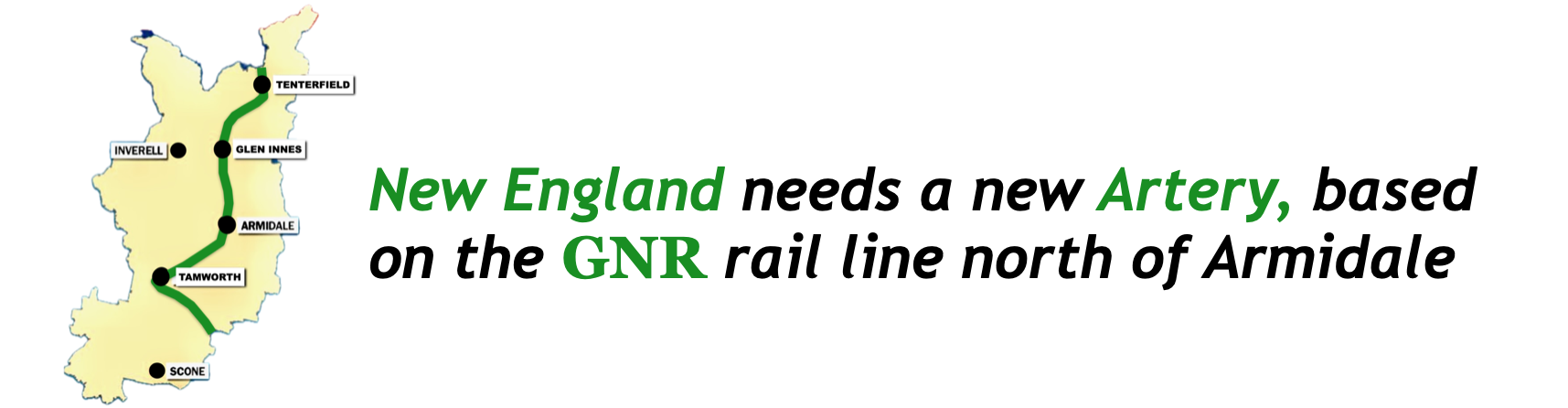
The railway line (currently non-operational) between Armidale and the QLD border could be re-developed as a freight line as a key part of the strategy towards achieving the net zero carbon emissions target, as well as to reduce road trauma with all its associated costs, and road maintenance and repair expenditures.
The NSW and Federal governments and freight industry need to look at roads and rail not as binary, or exclusionary infrastructure construct, but as constructs that can help in interoperability, coordination and integration or indeed as alternative avenues for the freight task. However, our belief is that the current approach is flawed in that the restoration of rail line for freight is being viewed by the industry as a threat to the existing arrangements to transport freight by road. In the face of the challenges we are facing in the next decades in terms of population growth, climate change and technological advancements, as well as the imperative to improve efficiency, sustainability and productivity, government and industry need to look seriously at how to use abandoned public assets such as the railway line north of Armidale for future freight tasks alongside mechanisms to move freight from road to rail.
The current XPT service between Sydney and Armidale via Tamworth only runs a passenger service. The line is not currently used as a freight service. If this section is improved to handle freight task, it can help producers, businesses, etc, in Armidale and surrounding areas on the one hand and increase the supply of freight to Tamworth Intermodal terminal on the other.
Until the late 1980s trains operated between Sydney and Tenterfield daily for freight and passengers. There was also a mail service byrail. Prior to that we believe that the line was upgraded at least halfway. The steel rails are still in good condition. Sleepers need to be replaced fully or partially depending on the purpose. Some bridges and culverts need repair. There are one or two highway crossings requiring some attention. Most railway stations still exist.
If the GNR line is re-activated, it would have multiple benefits for the primary producers, manufacturers, businesses, and builders. Large organisations like our hospital and university could also benefit.
In such an exercise, the benefits of linking the northern rail line with Inland Rail to the north at a point like Toowoomba should be examined (see below).
For the future NSW freight task, there is a need to establish several Intermodal Terminals in towns such as Glen Innes and Tenterfield. An Intermodal in Glen Innes could also attract freight from Inverell.
The NSW Government has stated that it does not have any plans to extend regional rail in the near future, i.e. the Country Regional Network. Instead, its policy seems to be to support local councils to remove the existing rail infrastructure (currently non-operational) to construct bike trails for recreation purposes. This policy is very concerning to us and needs reviewing with further, more extensive, public consultation. The NSW Rail Trail Framework also needs critical scrutiny.
At a time when Australia’s competitors such as Indonesia, Malaysia, China and even a small country like East Timor, are giving priority to rail freight, we seem to be going in the opposite direction.
Australia’s love for roads, trucks and airports will set us back for generations unless necessary steps are taken now to correct this course.
The NSW government can consider re-developing the GNR line for freight based on a Public-Private Partnership (PPP) model in collaboration with the private sector. In addition to delivering a climate dividend, it would provide an efficient freight service that can be used by the many large freight companies who currently only have the option to use trucks on highways. However, if the government leaves this to the industry alone, we think the chances of this happening is nil.
It is worth noting that the expenditure on constructing bypasses of regional towns alone cost hundreds of millions of dollars. The planned Tenterfield bypass is estimated to cost more than $200m.
While freight is the most significant consideration, the parallel benefit of greater choice for public transport by rail between Armidale and the towns to the north of us would benefit local residents and can be an additional tourist attraction for the region.
4. Inland Rail – No use to the New England Region
The Inland Rail being developed to the west of the New England region is of no direct benefit to us. The closest point from Armidale to connect with this rail line is either Moree or Toowoomba. Both places are several hundred kilometres away by road. It is unlikely that our primary producers, businesses, manufacturers, or indeed large public organisations will use this line to import or export products. This means continued reliance by the freight industry on roads and trucks.
Additionally, the delays and cost blow-outs in the Inland rail project may discourage any potential user from looking west or north to transport freight. They are more likely to look south. This situation will continue to contribute to the “supply chain congestion” described in your consultation paper rather than reduce it.
If the Inland Rail is to be of any major benefit for NSW, new East-West rail links connecting the coastal cities with the Inland rail need to be contemplated for the future. Such connections can be road or rail depending on the expected volumes and efficiencies to be gained. We are aware that our locals have been proposing such East-West connections for decades with no government attention.
The redevelopment of the existing northern rail line could be planned so that it connects with the Intermodal in Toowoomba, thus providing an extended rail freight option for the multitude of producers along this route.
5. Ports
For the New England region, it makes more economic sense to use the Newcastle Port rather than Port Botany or the Port of Melbourne.
A significant benefit of facilitating this would be to reduce the congestion in the Metropolitan rail network and on the road network in Sydney. Additionally, the road and rail networks need to be further developed for the freight task connecting the port with the inland region(s) where the supplies for the metropolitan and overseas markets are produced. In short to address the issues associated with Port
Botany and the metropolitan rail network in terms of mode share, timetabling, access etcetera, the only available solution is decentralisation of freight task to Port Kembla and Newcastle. This requires visionary thinking and action with a medium to long term plan.
It is noted that much of the liquid fuel is imported via the Newcastle port and there is a hydrogen production hub nearby. As the Hunter region is being promoted as an area that will have alternative energy transmission lines for renewable energy produced in New England as well, it is important to examine the possibilities of electrification of rail line north of Newcastle with solar energy, for example.
The consultation paper mentions that there is a plan to load and unload containers at the port. This is welcome news. If the port is planning this, as stated above it is essential the necessary transport infrastructure is built to transport produce from the regional areas and distribute imported supplies to regional New England and even to Queensland. As a dedicated freight line can be expensive, we believe that the better option available is to share the existing rail line to Armidale and restore the rail line from Armidale to Queensland for passenger and freight services.
Import costs can also be reduced for businesses by using Newcastle port compared with Port Botany or Melbourne port.
Should the re-activation of the GNR line materialise, importing and exporting produce and goods from Port of Brisbane could also be a possibility if it is linked to Inland Rail.
There is no obvious reason that state borders should prevent such innovative steps being planned and materialised. We understand that millions of solar panels and other equipment required for solar farms in New England are being imported by road from Adelaide. They could easily be transported by rail if the rail line from Tamworth to QLD is restored for freight.
6. New England Renewable Energy Zone (REZ)
A range of projects are underway to produce solar, wind and hydro energy in this zone. Our understanding is that the energy produced will be transmitted to Newcastle-Hunter and Sydney rather than used locally. If this is the case, it is very unfortunate. A percentage should be allocated for local use.
For example, such energy can be used for transport – both rail and road, but in particular for the electrification of trains. There is a solar company owner who proposes that such trains can be operated with solar batteries and charging mechanisms installed along the line. Government could view the New England region not only as a REZ but also one that develops industries associated with renewable energy.
It is imperative that consideration is given to the new, extra loading on road use that commenced recently and will be ongoing, regarding the transport of solar panels and windmill components. The impact on the road infrastructure will be immense. The construction phase will be followed in the next 5-10 years with the breakdown and/or obsolescence of components, which will require not only the freighting into the REZ of replacement components, but also the development of recycling factories and other means of disposal for the waste emanating from the redundant components.
By way of an example of the impact on roads in the Northern Tablelands, the data from Walcha shows that components for 119 wind turbines will be transported to Walcha on the New England highway. It is calculated that this will require 227 trucks per day for 2 years. These trucks are 90-metre-long B- Doubles coming from Newcastle all the way to Walcha. This equates to one truck every 15 minutes on the Walcha Road. For anyone with a last-minute appointment or there is an emergency will be delayed because those trucks are massive and there is no way to get around them. It is likely that a Council rate increase will be required to pay for the upkeep of the roads. This is an unjust burden on residents in each of the affected LGAs since it does not stop with Walcha; residents across the reach of the REZ will be affected. In total, 1200 wind turbines 8.6 million solar panels are proposed to be built in the beautiful New England countryside and productive farmland. It seems illogical to disturb, disrupt and in some cases destroy the natural environment and considerable numbers of wildlife for the purpose of “saving the planet”. Has the State government given any consideration to confining renewable energy sources as much as is possible to the rooves of existing built infrastructure? Generating electricity as close to the consumers as is possible would facilitate a significant decrease in emissions and reduce the burden on the roads in NSW.
7. Concluding Remarks
In this submission, ARRA is providing our preliminary thoughts about the NSW freight task, key issues mentioned in the consultation paper, and possible ways to resolve the issues using New England as a case for illustration.
We believe that the points made in our submission are applicable to other regions in NSW as well, forexample, the Northern Rivers region.
If an opportunity is made available, we are happy to expand on the comments in person or via zoom.
Armidale Regional Rateplayers Association
arra2350@yindi1951
6-jun-2024