Vehicles
We believe little is planned to carry out any major upgrades to the main highway in the New England. Works are confined to minor upgrades, road safety improvements and black spot corrections.
There has been dramatic increase in the size of articulated freight vehicles, particularly for long haulage of containers and bulk grain transport.
Many of the rural roads are dirt or light gravel formation. Large grain and livestock trucks tow multiple trailers now. They have cause significant damage rural road surfaces in New England.
Each wind mill for generating power in a wind farm requires about 12 heavy, often over dimension and over mass vehicles, passing over regional roadways. As the REZ program accelerates much major extra road maintenance will be required.
Many road bridges in New England are now well past their design capacity and planned life span. This will require significant capital injection by NSW and/or federal government.
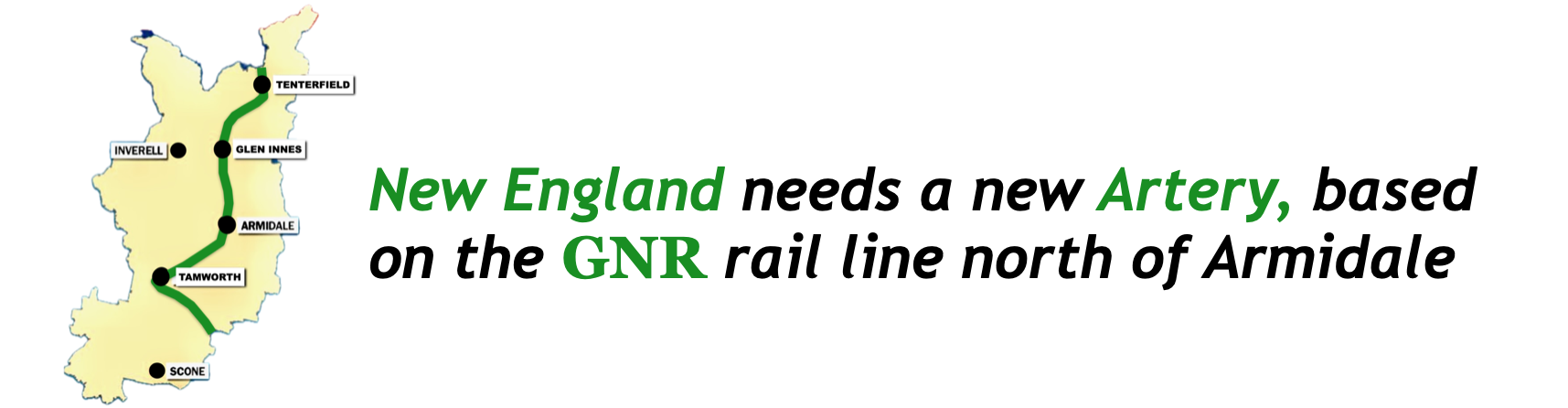
The re-activation of the GNR line, and its connection with Brisbane, Toowoomba and Newcastle, may well be a cheaper and better option than constantband-aid patching of the highways and roads network.
Trains
Re-establish the GNR Line from Armidale to Wallangara QLD, then onwards to Brisbane and/or Toowoomba
NSW Premier Chris Minns on the 15 March 2024 said “Everyone deserves access to good public transport – regardless of where you live. And we’re delivering it.”
By 2032 there will be a network of four new Sydney Metro lines, With 46 stations and 113km of new metro rail at a cost of $64 billion that’s about $570 million per km.
In the New England $570 million would connect Armidale to QLD and generate huge economic and social benefits for the region.
Prior to the closing of the GNR line the New England region was one of the wealthiest, productive regions of NSW, with considerable wealth derived from agriculture and some mining. That wealth provided a quality lifestyle, good education and ever since 1954 a first-rate residential University.
For about 30 years the New England was a major driver of the New State Movement. Following the defeat of the referendum in 1967 it seems that succeeding NSW governments, both Labor and LNP, have withheld resources, economic and political commitment. The New England federal electorate boundary has expanded to as far south as Muswellbrook for the coming federal election. The inclusion of a mining region, which tradionally votes Labor, will add greater pressure on the Nationals to retain the seat on 3-may-2025.
With the massive growth and expansion of SEQ it is inevitable that the New England region will develop ever increasing economic, health, social, educational and tourism ties.
The re-establishment of the GNR line between Armidale and SEQ is absolutely essential and is strongly supported by the NSW Government’s 2056 transport strategy.
“Future Transport 2056” outlines six state-wide principles to guide planning and investment. These are aimed at harnessing rapid change and developing new technologies and innovation to support a modern, innovative and resilient transport network.
1. Customer focused
Customer experiences are seamless, interactive and personalised, supported by technology and data.
2. Successful places
The liveability, amenity and economic success of communities and places should be enhanced by transport.
3. A strong economy
The transport system powers NSW’s future $1.3 trillion economy and enables economic activity across the State.
4. Safety and performance
Every customer should enjoy safe travel across a high performing, efficient network.
5. Accessible Services
Transport should enable everyone to get the most out of life, wherever they live and whatever their age. ability or personal circumstances.
6. Sustainability
The transport system should be economical and environmentally sustainable, affordable for customers and support emissions reductions.
Clearly the New England Region will fail to meet the 2056 Transport Targets for NSW, unless considerable work commences to immediately to: –
6.1 Re-activate the operation of freight, passenger and tourist trains on the GNR line between Armidale to Jennings and Wallangarra QLD.
6.2 Enhance the operation of freight, passenger and tourist trains train service between Armidale and Newcastle.
6.3 Implement an East West rail corridor from Moree to Grafton via Inverell and Glen Innes.
6.4 Connect the rail services in NSW for freight, passenger and tourist trains to Brisbane and Toowoomba, with the co-operation of the QLD government.
6.5 Develop integrated transport options within the New England region with the expanded rail system using coaches, buses and active transport to meet the regions needs for the rest of the 21st century.
Rick Banyard
Project Director
New England Transport Plan
1-may-2025
