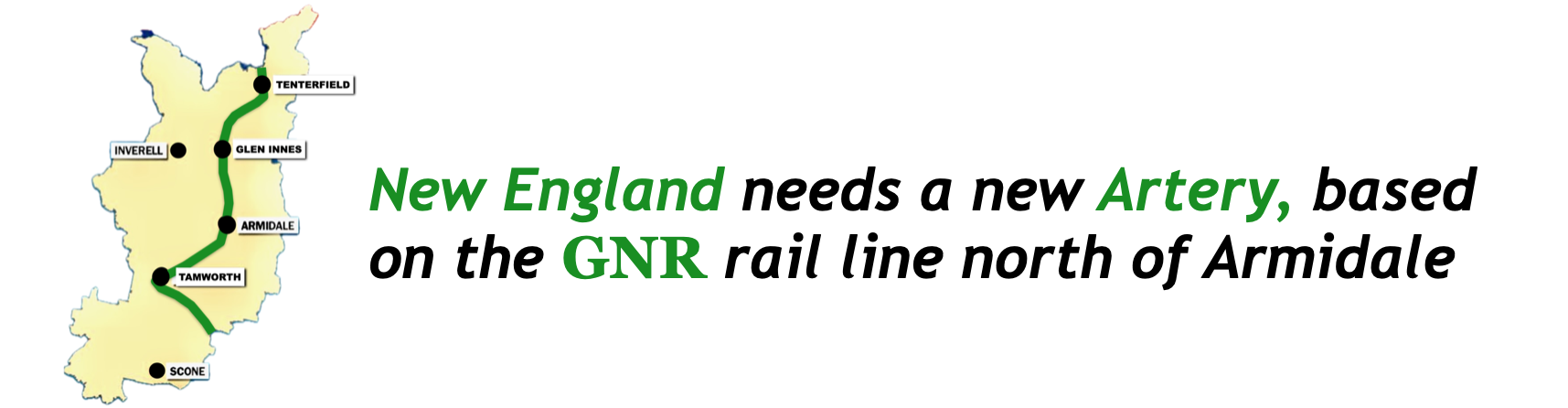
1. Creating the GNR Artery
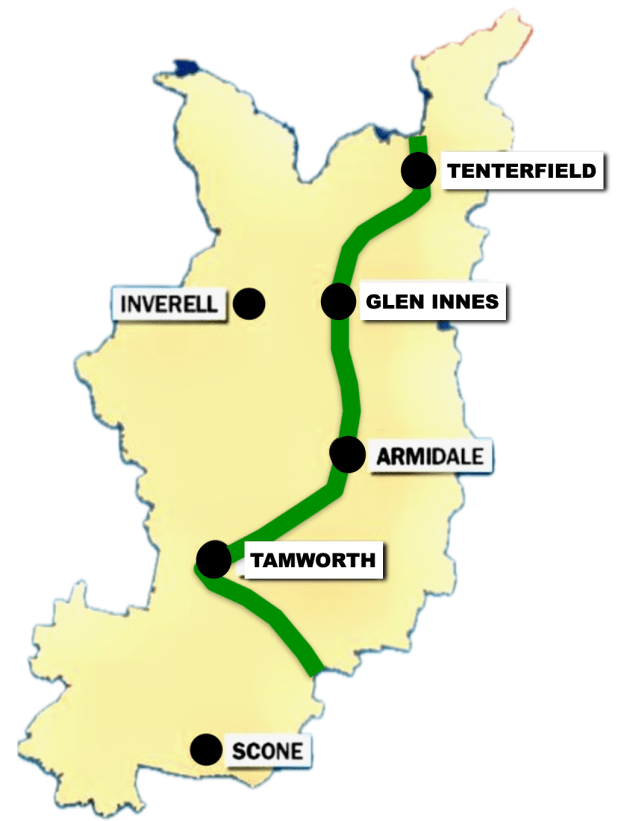
The Great Northern Railway (GNR) is a public asset built by the colonial government in 1800s with considerable material and human costs. It is believed that between 15 and 18 Aboriginal workers sacrificed their life in the construction phase. During the war years, the line was used to transport men, material, machinery, and supplies between NSW and QLD. Folklore suggests that even a hospital train equipped with nurses travelled on the line. Though the GNR line has not been used for rail services for 34 years, since the late 80s north of Armidale to the QLD border, circumstances dictate that the NSW government and Federal government need to urgently examine the significance of the GNR line for defence purposes, as well as economic and social benefits to be generated. While the government focus is about the sea and air defences for future national contingencies, our view is that rail infrastructure covering most of NSW and the nation has to be improved to the standards required in the 21st century.
While our neighbouring countries are building fast trains between cities and regions, we do not seem to follow suit. Even Victoria has the V Line which is a limited stop fast train connecting regions with the city. In NSW we do not have similar services. Moreover, in NSW there are more non-operational rail lines than operational ones. Most of them are in the regions.
Thus the government, private sector companies, local councils, other stakeholders and community organisations need to be planning our regional rail network now, for the next 5 decades at the least. We cannot be complacent and only react to emergencies and natural disasters like floods, fires, and storms which come on our way regularly due to the changes in climate. Whether we agree with the fact of climate change or not, we cannot ignore the disruptions to human life from such weather related events.
Why not re-activate a public asset like the GNR for inter-state connectivity, better human mobility and comfortable, reliable public transport?
New England is a Renewable Energy Zone (REZ), a State significant project where many companies have invested in renewable energy projects. More are planned. The workforce is drawn from various parts of the country and overseas. A transmission line from the REZ is being built to take the energy produced to Newcastle and Sydney.
Many residents ask what is the benefit to us from the REZ? Some companies have made an annual monetary contribution to Armidale Regional Council for several decades. One such contribution is to be ear marked for the rail trail though.
Why not be more creative and use the energy created to run future trains on GNR? That will produce a better community benefit. As much as the REZ has attracted various players from the private sector, if the GNR is revived north of Armidale it can provide a boost to further investments in housing, farming, industry and business. More professionals such as health care workers, educationists, tourism operators will also focus on the regions with such infrastructure development. Given the fact that University of New England is setting up a campus in Tamworth, introduction of a second train, or a heritage train, between Armidale and Tamworth will be helpful for university staff, students and parents alike.
Re-activating the GNR line north of Armidale to Wallangarra in QLD will have a dramatic effect on all aspects of life in the New England region. It will have a dramatic effect on the economy of the Northern Tablelands because it will bring more residents, jobs and business. Glen Innes, Tenterfield and surrounding areas are prime agricultural land for food production. But value adding food processing and manufacturing enterprisses can also be established to generate a secondary outcome.
Medical services in Armidale are already working to capacity and there is a serious lack doctors in smaller towns. Residents need get better transport access now to top end medical services in Sydney, Newcastle, Brisbane and Toowoomba. This could be done with new bus services in the short term, but ultimately having a 21st century quality rail service on the GNR line is the medium and longterm solution.
It will take many heavy trucks out of the city, towns and villages strung along the New England Highway A15. Accidents on the highway can be avoided and the road repair bill reduced dramatically. One interstate freight train has the capacity to replace about 30 semi-trailers and B-double trucks. Savings on diesel is also significant. According to one estimate is 90,000 litres of diesel daily on the New England Highway alone.
The justification for federal govt, NSW government and the private sector will be largely driven by the economic benefits of moving containerised and high volume items like wheat, barley, minerals, sand, etc, onto a modern rail line linking SE QLD, the New England, Sydney, Parkes, Perth and Adelaide. The GNR route is already there. Parts of it will benefit from re-alignment to straighten the line and avoid steep climbs.
Connecting the GNR line with the QLD rail network will produce a range of benefits for the New England economy and society. The inflow of new residents will increase. along with those who provide services and those who want to get quality higher education. In time to come towns such as Armidale, Glen Innes and Tenterfield can be transformed to be mini cosmopolitan cities – quite a contrast to the current situation where population growth is stagnant.
Compare the huge ongoing costs of road freight and damage to roads, having to build by-passes with dramatic decreases road accidents, and vast reductions in diesel fumes for the residents of the New England.
But our recommendations are not based on rail alone. The total benefits to the local, NSW and national economy will come from integrating the GNR Artery with local road network using minor and major intermodal facilities, co-ordinating rail, bus, coach and air services so that passengers – young and old, fit or disabled – have more choice of transport modes and frequency.
The following sub-sections identify improvements that can be made to other forms of transport within and through the New England:-
Social Benefits will also be many. With better mobility, residents will have access to cafes and restaurants for entertainment. The cinema, art, music, and other culturally important activities will be enriched with more patrons. Organic food production and consumption can also be aided with such intermixing of people. Cross fertilisation of town and gown can produce creative energies among the residents with potential growth in creative industries.
Re-activating the GNR Artery is not simply a plan for transport infrastructure. It can be the lifeline of the region’s future prosperity and growth. Further neglect of this public asset by elected bodies at Council and State levels, in particular, will be a regressive measure.
The following sub-sections identify improvements that can be made to other forms of transport within and through
the New England:-
2. Inland Rail
Though this project is progressing with the aim of transporting freight between Brisbane and Melbourne in 24 hours, authorities are interested in connecting road and rail lines that can supplement the role played by Inland Rail. In fact Inland Rail has funded several such projects already. GNR can be a rail line connecting with Inland rail at Toowoomba, Gaurie or another location over the border. Connecting Tamworth Intermodal with the Toowoomba Intermodal by rail via Armidale makes good sense.
The Inland Rail project will have significant impact on the flow of freight within NSW and Interstate. Although the Inland Rail project travels through Narrabri and Moree it will have impacts on the New England for the following reasons: –
- The Inland Rail will stimulate the movement of freight by rail and in particular by the double stacking of containers.
- The Inland Rail will stimulate the freight flow to the Port of Brisbane and possibly the Port of Melbourne.
- The Inland Rail may also simulate the Port of Newcastle especially if the rail line from Walgett to Newcastle via Narrabri, Werris Creek and Muswellbrook is improved. The Ardglen Tunnel is in need of a major upgrade.
- The Inland Rail probable connection with the Port of Gladstone could be a major distraction to the use of Brisbane, Newcastle and Melbourne as the key port connections.
3. Bus
Earlier we provided information about the nature of bus services in New England. Compared to metropolitan areas like Sydney, Newcastle or Wollongong, or even main regional centres, towns in New England lack bus services connecting them on a regular basis. Once a day bus service between Armidale and Tenterfield to connect with the train service to Sydney is not sufficient to meet the actual needs of residents. Someone who takes the daily coach from Glen Innes or Tenterfield or nearby villages has to stay until 6.00pm to take the return coach. This is not even the case in Third World countries!
In this context we are glad to note the annoucement by TfNSW that there will be a thrice weekly bus service from Armidale to Port Macquarie from the middle of 2025. However residents are seeking better bus services connecting their towns and villages, especially those living in Glen Innes and Tenterfield.
In order to give passengers a seamless connection they may need to use several modes of passenger transport to get from the start to the end of their journey. The most effective way of effecting this operation would be by utilising strategically placed interchanges. Armidale, Glen Innes and Tenterfield should all have interchanges.
The use of school buses as on demand services will assist people to get to and from the Interchanges.
4. Plane
The difficulties that the travelling public face with high air fares and frequent disruptions to flight times have been noted already. This includes the closure of Armidale Airport for repairs early in 2025 and the deployment of buses to Tamworth Airport by the Armidale Regional Council. There needs to be better integration of air services between Armidale and Tamworth airports. Likewise, a shuttle train service combined with buses between two airports will also be valuable for both cities.
Qantas could introduce a service from Armidale via Coffs Harbour to Sydney and even to Brisbane. This will be helpful for Armidale, Glen Innes to attract more visitors from the coast. It will also help residents to access medical facilities in Coffs Harbour, especialy with specialist services lacking in Armidale, Glen Innes and Tenterfield.
If there is a train service north of Armidale, air services can be combined with such train services for visitors to go to places of interest to touists in wider New England. The same applies with additional bus services.
The Tamworth Regional Airport Master Plan establishes a framework for the future development of the airport and addresses existing airport activities as well as opportunities for growth in aviation and aviation-related activities.
Other airports will also need to adopt long term planning strategies.
The QLD government subsidises regional air services. The NSW government can seriously look at this option as well.
5.0 Active and Other Transport Modes
5.1 Taxi and Uber
Taxi and Uber services are minimal, and changes will be directly related to changes in major transport offerings. Extra aircraft flights, the introduction of additional bus services and an increase in train services will generate demand for extra taxi and Uber services and probably extra patronage on local bus route services too.
5.2 Bikes
The massive number of bike trails in the New England would seem to indicate a gross oversupply of cycling options. Some bike events could be improved, and additional resources spent on advertising and promotion. The severe absence of existing bike trail statistics is hindering the potential of the bike activities to develop tourism revenue particularly for Armidale City and Glen Innes township.
New England Regional Bike Clubs and community organisations need to take control of the regional bike activity and not be influenced by other bodies from remote locations.
According to RamPLAN 2023 only 69 people rode a bicycle to work in the Armidale Regional Council area and in Glen Innes Shire only 10 rode bikes to work.
It is certainly very difficult to believe that people in their thousands are going to ride a long and very demanding rail trail.
5.3 Walking
Walking is stimulated by having formed footpaths normally made from concrete. These provide a stable all-weather surface. The target for cities and larger towns is for at least 10 per cent of trips made will be made by bicycle and 50 per cent by pedestrian movement on structured pathways.
Good design and layout of elements are: –
• Creates a safe street;
• Reinforce the street hierarchy;
• Provide required paths of travel and pedestrian priority;
• Provide a clear and direct composition that reinforces the major design elements;
• Integrate seamlessly into the paved ground plane; and
• Are located consistently throughout the public domain to reflect the overall special character.
There are many competing factors that need to be considered when allocating space across urban streets including factors such as: –
• Available pedestrian and vehicle through movement space;
• Anticipated pedestrian volumes;
• Anticipated traffic volumes and speeds;
• Safety and accessibility for all users;
• Transportation routes and locations of shelters and transfer points;
• Future projections for cycleway users;
• Anticipated shared pedestrian zones and cycleways; and
• Necessary street infrastructure.
After these factors have been considered path design can be commenced.
Generally pedestrian footpaths are 1.8m wide and where pathways are shared with bicycles or scooters the width will range from 2.5m to 4m. Usually the path face is 600mm from the kerb. Armidale, Glen Innes and Tenterfield all have significant need for structured pathways. This need will increase as the population ages and mobility devices become more common.
Pathways are commonly funded with Federal government Grant Funds and are often combined with training or employment programs. But Councils have the main responsibility for maintaining footpaths. Often there are walking and cycling paths going through the town and the public parks.
Rick Banyard
Project Director
New England Network
2-jun-2025
